The Neighborhood Machine: How Yanase-Minami's Vending Corners Became the Most Human Places on the Block
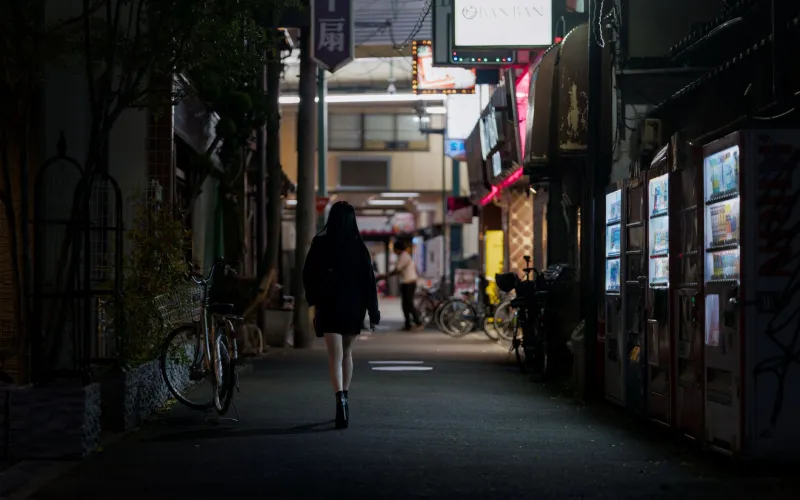
The Glow at the End of the Alley
It's past 11 p.m. on a Tuesday in Yanase-Minami, and the convenience stores have cut their foot traffic to a trickle. But on the corner of a narrow residential street—wedged between a shuttered dry cleaner and someone's garden wall—two vending machines are doing brisk business. A delivery worker in a reflective vest feeds in coins for a hot canned coffee. An elderly man in slippers shuffles up, makes his selection without looking (he clearly knows the machine by heart), and shuffles back the way he came. A pair of high schoolers debate between two flavors of sports drink.
Three transactions. Maybe four minutes total. Nobody spoke to anyone else.
And yet, somehow, this felt like a neighborhood.
That tension—between automation and intimacy, between convenience and community—is exactly what makes vending machine culture in Japan so hard to explain to Americans and so worth trying to understand.
Scale That Defies Expectation
First, some numbers, because they're genuinely staggering. Japan has somewhere in the neighborhood of 4 to 5 million vending machines—roughly one for every 23 people. That's the highest density in the world by a significant margin. Yanase-Minami, like most urban and semi-urban Japanese neighborhoods, reflects this: you're almost never more than a two-minute walk from a machine.
They sell the obvious stuff—sodas, water, coffee, tea—but also hot soups, energy drinks, canned sake, fresh eggs, umbrellas, ramen kits, and in some more eccentric corners of Japan, items that would make a 7-Eleven blush. In Yanase-Minami, the machines tend toward the practical and the comforting: warm beverages dominate in winter, cold ones in summer, and there's almost always at least one machine nearby stocked with the kind of hot canned corn soup that tastes like childhood to anyone who grew up here.
Why They Work Where They Work
The placement of vending machines in Japanese neighborhoods isn't random, even when it looks like it. Many machines are owned and maintained by local operators—sometimes individuals, sometimes small companies—who have spent years figuring out exactly what a particular corner needs at particular times of day.
Yoshida-san, who operates three machines in the Yanase-Minami area, has been doing this for over a decade. He visits each machine every few days, restocking based not just on inventory data but on feel. "I know which machine runs out of hot coffee first on cold mornings. I know which one the construction crew uses. You learn the rhythm of the street."
That human knowledge embedded in an ostensibly automated system is part of what makes Japanese vending culture feel different from, say, a bank of machines in an American airport. Someone chose what goes in that machine. Someone is paying attention to what you're buying. There's a quiet accountability in that.
Trust as Infrastructure
Here's something that genuinely takes Americans a moment to process: many vending machines in Japan operate with essentially no security. They're outdoors, often in unlit alleys, often stocked with cash. Vandalism is rare. Theft is rarer.
This isn't just a Japan-is-safe cliché. It reflects something real about the social contract that vending machines participate in. They exist because people treat them well. They're maintained because operators trust the community. The community trusts the operators to keep them stocked and functional. It's a loop of low-level, daily mutual reliability that most Americans don't have a good framework for thinking about.
"In the U.S., you assume something unattended will be broken or stolen," says Dr. Naomi Ishikawa, a cultural anthropologist who has studied consumer behavior in Japanese urban spaces. "In Japan, there's a default assumption of shared responsibility for shared spaces. The vending machine is a test of that assumption—and it keeps passing."
More Than a Transaction
Ask longtime Yanase-Minami residents about vending machines and you'll hear stories that have nothing to do with beverages.
One woman describes how, after her husband passed away, the nightly walk to the corner machine became her way of getting herself outside and moving. "It gave me a reason to leave the apartment. Just a small one. But small reasons matter."
A local shop owner mentions that the machine outside his storefront became an informal gathering point for neighborhood kids after school—not because of anything special about the machine itself, but because it was a neutral, accessible, always-open space with no pressure to buy anything expensive or stay any particular length of time.
A night-shift nurse talks about the machine outside her hospital as a small ritual of normalcy at the end of brutal shifts. "Hot coffee at 3 a.m. It doesn't sound like much. But it's consistent. It's always there. That matters more than people realize."
Consistency. That might be the vending machine's most underrated quality. In a neighborhood that changes—businesses open and close, people move in and out—the machine on the corner persists. Same location, same warm glow, same mechanical hum. It becomes a kind of fixed point.
What the American Comparison Gets Wrong
In the U.S., vending machines are associated with airports, office break rooms, and the depressing corners of hospital waiting areas. They're transactional in the most stripped-down sense—you put in money, you get a product, you leave. Nobody romanticizes them.
The instinct, when hearing about Japan's vending machine culture, is to project that same energy onto it and assume the density of machines must indicate something cold or isolating about Japanese social life. The opposite is closer to the truth.
The machines work because Japanese neighborhoods have strong social fabric, not in place of it. They're trusted because trust already exists. They're used communally because community already exists. They're not a substitute for human connection—they're infrastructure that human connection runs through.
A Different Kind of Convenience
Walking back through Yanase-Minami as the evening winds down, it's hard not to see the machines differently than you did a few hours ago. The glow from that corner isn't the glow of automation replacing something human. It's more like a streetlight—a piece of shared infrastructure that makes the neighborhood function a little better, that's maintained by someone who cares about it, that people rely on without thinking much about why.
Yoshida-san is loading up his van for tomorrow's restocking run. He checks his notebook—actual paper, actual handwriting—and confirms which machines need what.
"People think it's a simple business," he says. "Put machine on corner, collect money. But you have to know the people. You have to know the street. Otherwise you're just selling things nobody wants."
That's not a bad summary of community, actually.