Wrapped in Meaning: Why Yanase-Minami's Gift Shops Treat the Outside as Seriously as the Inside
Walk into almost any gift shop along Yanase-Minami's older commercial streets and you'll notice something that stops most American visitors cold: the staff behind the counter wrapping a purchase with the same focused intensity a surgeon brings to an operating table. Fingers pressing crisp folds. Ribbon cut to an almost mathematical precision. A small wax seal placed not randomly, but exactly where it belongs.
This isn't performance. It's culture — and in Yanase-Minami, it runs deep.
The Package Is the Message
In Japan, the concept of tatemae — the public face you present to the world — bleeds into nearly every social interaction, including how you hand someone a gift. But to reduce Yanase-Minami's wrapping traditions to mere social formality would be selling it short. Locals here will tell you that the wrapping is a form of communication, a silent statement about how much you value the relationship.
"When I wrap something for a customer, I'm wrapping their feelings, not just the object," says one shopkeeper at a long-running stationery and gift boutique near the neighborhood's covered shopping arcade. She's been wrapping gifts professionally for over 30 years and can fold a furoshiki cloth around an irregularly shaped box in under two minutes without a single visible crease.
That idea — that the wrapper holds the emotion of the giver — is why you'll see Yanase-Minami residents take genuine offense at a carelessly presented gift. It's not about materialism. It's about what the effort communicates.
Layers Upon Layers
What surprises most Western visitors is just how many layers are involved. A typical upscale gift from one of the neighborhood's specialty shops might include: tissue paper around the item itself, a fitted inner box, decorative outer wrapping paper folded in the hyakkaten department-store style (a specific diagonal fold that looks deceptively simple but takes real practice), a paper band or noshi decoration, and finally a handled bag printed with the shop's name.
Each layer serves a function. The tissue protects. The inner box structures. The outer wrap signals the occasion. The noshi — originally a strip of dried abalone, now a stylized paper ornament — marks the gift as ceremonial rather than casual. And the bag? That's practically a business card for the shop, a guarantee of quality by association.
Strip any one of those layers away, and you've changed the meaning of the gift entirely.
Seasons Change the Rules
One of the more fascinating dimensions of Yanase-Minami's gift culture is how dramatically it shifts with the calendar. The neighborhood has two major gifting seasons that parallel Japan's national traditions: ochugen in midsummer and oseibo near year's end. During these windows, the specialty shops along the main shopping street transform completely.
Summer wrapping tends toward cooler tones — pale blues, white, soft greens — with lighter papers that feel airy rather than heavy. Winter gifts lean into deeper reds, golds, and the kind of rich jewel tones that feel warm against the cold. Even the ribbon styles change. A summer presentation might use a simple flat bow; a winter gift often features layered, architectural knots that look almost like origami sculptures sitting on top of the package.
Local florists and confectionery shops coordinate their wrapping palettes with their seasonal inventories, so a box of autumn wagashi sweets might arrive in wrapping paper printed with maple leaves in exactly the right shade of burnt orange. It's a level of thematic coherence that most American gift wrap aisles can only dream of.
The Furoshiki Revival
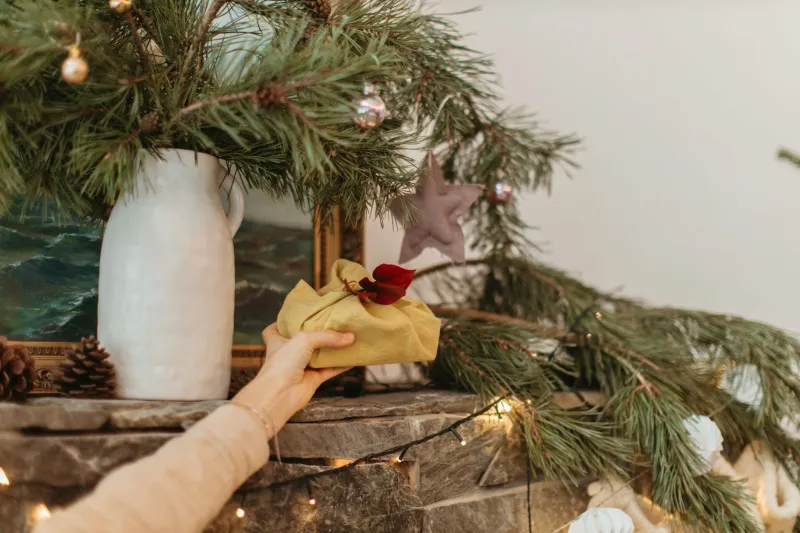
If you spend enough time in Yanase-Minami's shops, you'll notice a quiet resurgence of furoshiki — traditional Japanese wrapping cloth — especially among younger shopkeepers who are leaning into sustainability without abandoning elegance. Unlike disposable paper wrapping, furoshiki is reusable, and in Yanase-Minami, gifting something wrapped in a beautiful cloth is understood to mean the cloth itself is part of the gift.
The folding techniques for furoshiki are genuinely impressive. A skilled wrapper can secure a wine bottle, a melon, or a stacked set of lacquerware boxes using nothing but the cloth and a few specific knots. No tape. No scissors. Just geometry and practice.
Some of the neighborhood's newer boutiques have started offering furoshiki wrapping workshops on weekend afternoons, and they fill up fast — not just with curious tourists, but with Yanase-Minami residents who want to learn properly rather than approximate.
What American Gift-Givers Are Starting to Borrow
Here's where it gets interesting for a US audience: these ideas are traveling. If you've noticed American luxury retailers putting more effort into tissue paper layers, or lifestyle brands selling reusable cloth gift bags as a premium option, you're watching Yanase-Minami's philosophy arrive stateside — even if nobody's labeling it that way.
The core insight is transferable: presentation signals intention. When you take time with how something looks on the outside, you're telling the recipient that you thought about them beyond the act of purchasing. In a culture increasingly dominated by Amazon boxes and gift receipts, that message lands harder than it used to.
Some American hosts have started adopting the Japanese practice of receiving a gift with both hands and setting it aside to open later — a show of respect for the presentation rather than tearing into it immediately. It feels awkward at first, but the logic is sound: if someone wrapped something carefully, maybe it deserves a moment before it gets dismantled.
The Shopkeepers Who Keep the Standard
What makes Yanase-Minami's gift-wrapping culture genuinely special isn't a set of rules — it's the people who carry the knowledge. The older shopkeepers here learned from their predecessors, and they're quietly passing those skills along to younger staff who understand that a perfectly wrapped gift is a form of craft, not just customer service.
Next time you're in the neighborhood and you watch someone behind a counter fold paper with that particular, unhurried precision, don't be in a rush. You're watching something real. The gift inside might be lovely, but what's happening on the outside? That's the art.